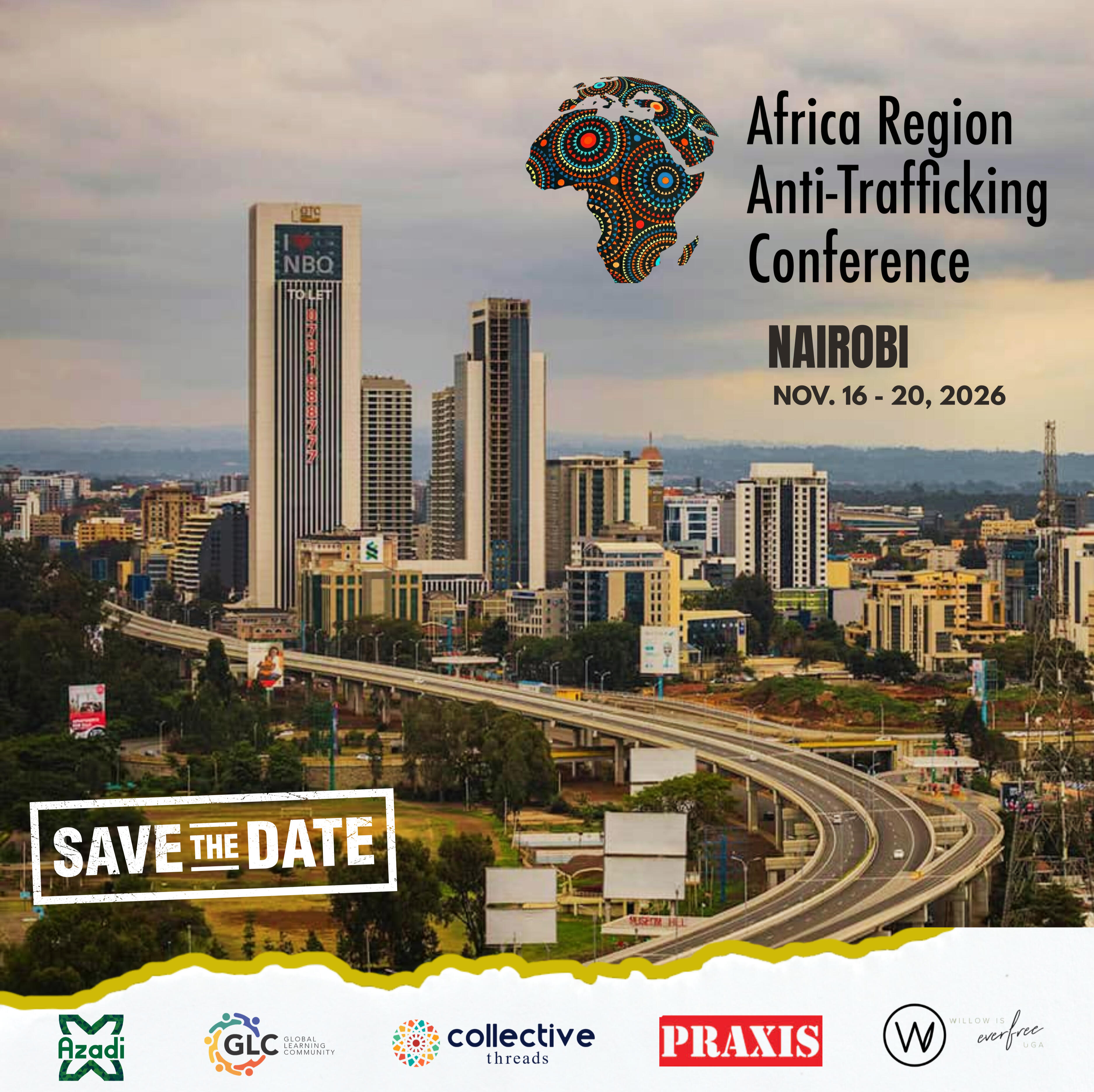
November 16-20, 2026
Nairobi, Kenya
Mission Statement
To foster collaboration and peer to peer learning across Africa in order to generate new ideasand energise cross-movement solutions to address the root causes of human trafficking.
The Africa Region Anti-Trafficking Conference is:
i. An intimate space for learning : the conference is designed to feel personalized and impactful. It will emphasize recognizing each participant’s uniqueness, practicing radical empathy, and fostering authentic connections. The conference will also focus on
practicality, ensuring people leave with tools, resources on participatory practicesii. Grassroot voices: the conference is designed intentionally to make sure practitioners in the grassroots are the ones leading the conference. Intentional to be sure that the people on stage are those who are from the grassroot space as opposed to having the
space dominated by bigger organisationsiii. Cross movement: a movement as a “set of people with a shared realities of injustices who organise to build their collective power and leadership.” The nature of human trafficking provides an opportunity for cross-movement work because the issues have roots in multiple movements
$ 250USD Early Bird (February-April 2026)
$ 300USD (May-August 2026)
*Tickets include entrance to the conference, breakfast, lunch, and evening snacks. Accommodations and travel and additional meals are not included.
With only 65 seats available, the AFRAT organizers want to ensure that African grassroots organizations and practitioners with lived experience are prioritized as attendees. Please fill out the application below, and our team will review your information. We will notify you by August 31st if we are able to offer you a seat at this year's conference.
Unlike a traditional conference, AFRAT is intended to be a participatory experience following the methodology of Praxis' "TheWorkshop."About TheWorkshop
TheWorkshop is Praxis’ flagship annual programme on participatory methods and approaches, now in its 27th edition. Over the past 26 years, it has evolved into a unique learning space that brings together funders, practitioners, researchers, community leaders, facilitators, and other allies to explore how participation can reshape knowledge, practice, and social change. TheWorkshop emphasises experiential learning, peer exchange, and reflection, enabling participants to deepen their methodological skills while examining the political and ethical dimensions of participation.Objectives of TheWorkshop
● To strengthen participant capacity in participatory research, facilitation, and action-oriented inquiry.
● To create an open and reflective space for practitioners to critically examine power, positionality, and knowledge hierarchies in their work.
● To explore how participatory tools, methods, and processes can be used to deepen inclusion, build collective analysis, and support community-led change.
● To support peer learning across diverse geographies, sectors, and lived experiences.Key Themes
● Participation and Power: Understanding how participation can challenge or reproduce existing power structures.
● Positionality and Reflexivity: Exploring the researcher–participant relationship, social conditioning, and the politics of knowledge.
● Collective Change: Connecting inquiry to action, examining models of collective mobilisation, and linking evidence to transformation.
● Narratives and Knowledge Production: Learning how stories, meaning-making, and analysis can shift dominant narratives and expand voice.Intended Outcomes
By the end of TheWorkshop, participants are expected to:
● Gain a grounded understanding of participatory principles, tools, and approaches.
● Develop deeper reflexivity about their work, their positionality, and the methods used in research.
● Strengthen their ability to design and facilitate participatory processes across research,
programming, and community engagement.
● Build connections with a diverse cohort of practitioners committed to inclusive and ethical practice.
● Leave with practical insights, frameworks, and confidence to embed participation more
meaningfully in their work.
The Africa Region Anti-Trafficking Conference is an initiative of the Global Learning Community, held in partnership with Azadi Community as a coordinator/ host organisation and Praxis Institute.The GLC is a culturally diverse international community with the mission to “collaboratively strengthen standards, facilitate connections and learning, and implement creative and innovative solutions within the anti-trafficking and modern slavery movement.” The Global Learning Community (GLC) now includes over 330 members from 60 countries around the world.Azadi Community is a survivor centered, value based organisation based in Nairobi that focuses on the provision of long-term support for survivors of trafficking who, too often, find a lack of community support and understanding when reintegrating into society ensuing their experience with trafficking. Azadi's goal is to create spaces and programmes that enhance the agency of survivors of trafficking, to support recovery from trauma, and to sustain their reintegration into society.Praxis – the Institute for Participatory Practices – is a knowledge organisation committed to democratising development by centring the voices, leadership, and lived experiences of those most affected by systemic inequities. Their work spans participatory research, capacity building, facilitation, and programme design, grounded in methods that shift power, strengthen community agency, and make knowledge creation more inclusive and accountable.The planning committee - Everfree, Collective Threads, Azadi Kenya, & the Global Learning
Community